
PokaMind Practice: rehearse the conversations that matter
Built on the Social AI engine: rehearse out loud, then see your tone of voice, pace, accent, words and body language from your webcam, and re-run it to see it change.
AI roleplay built from your playbooks. Sales, service and frontline teams practice their hardest conversations, then get a written breakdown.

Alex Renner (AI), procurement lead
“I have a cheaper quote on my desk. Tell me why we should renew.”
Your rep
“What has changed on your side since last year?”
See PokaMind Practice work
What you get
- An AI that plays the other side, built from your own material, in nine languages. It is always labeled (AI).
- Your delivery against your own baseline, with what to change next time. Accent coaching only if you turn it on.
- Rehearse for the context you choose, for example a negotiation with a more indirect style.
- Rehearse your next meeting from the open points in PokaMind Notes.
- Practice on your own for presentations, pitches and negotiation.
The written breakdown
After the session: what they said, how they said it and what to change.
- Pace
- 182 words a minute when you named the price. Your usual: 140.
- Tone of voice
- Your pitch rose at the end of "six percent", so it can sound like a question. Say it falling.
- Body language
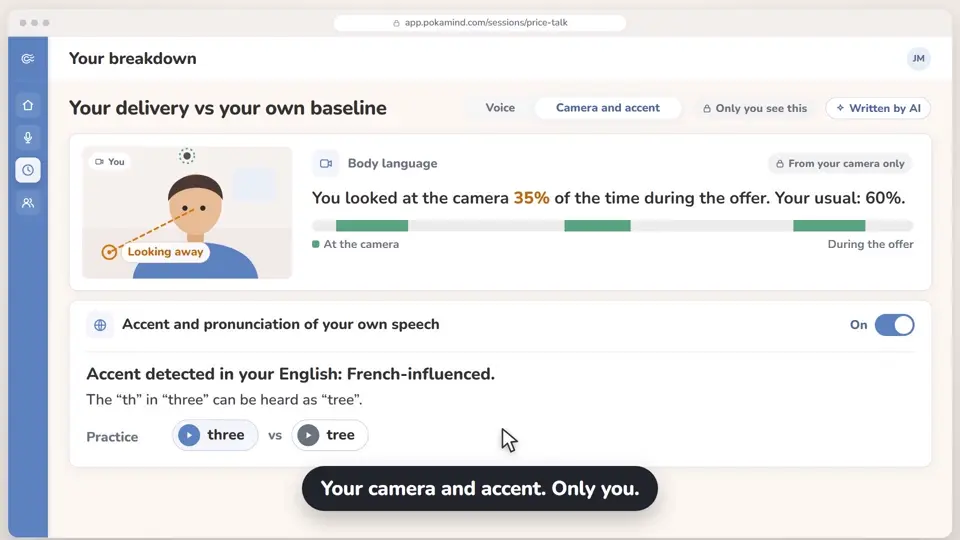
- You looked at the camera 35% of the time during the offer. Your usual: 60%.
- Accent detected in your English
- French-influenced. The "th" in "three" can be heard as "tree". Practice "three" vs "tree".
- Try next time
- Say the number with a falling pitch, then pause.
Short courses and drills
- A short course from your handbook
- Give us the handbook nobody reads, and your people get a short course with questions and drills. Someone on your side checks it first.
For sales and negotiation
Reps rehearse the renewal call before the one that counts.
The AI playsAlex Renner, procurement lead
“I have a cheaper quote on my desk. Tell me why we should renew.”
For customer and frontline teams
Service desks, contact centers and retail teams rehearse the call that starts upset.
For new hires
New hires practice the first real call before it happens.
From your onboarding guide, section 2
- The guide says
- Every new account gets a kickoff call within five working days of signing.
- Question
- A customer signs on a Thursday. What is the latest day for the kickoff call?
Security drills
Short drills on your own security policy, and a test phishing email, sent only when you decide.
Drill: your security policy, section 3
- The policy says
- Logins are never shared, even inside a team.
- Question
- A colleague asks to borrow your VPN login for one afternoon. What do you say?
While it felt a bit unusual talking to a screen during the training, the results and feedback have been excellent. It’s definitely worth it. It has created a safe learning environment for our teams.
Emma MeurlingVP Human Resources, BioInvent International AB
What Practice will not do
- It records only when you start a session, and the camera is optional.
- Your feedback and the conversation stay with you. Managers see who practiced and how often.
- It is not for evaluating people, and our customer terms say so.
- It does not read emotions or infer anyone's origin or background. It measures observable signals of your own delivery, and accent detection looks only at your own speech, if you turn it on.
- It suggests. You decide.
- The other side is an AI, and is always labeled (AI).
- For adults at work, 18 and over. Not offered to schools or universities. Read the privacy notice (opens in a new tab).